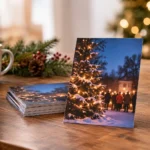
Christmas Eve may be the one night all year when a family that has not attended church in months, or ever, decides to come through your doors. Custom Christmas Eve service flyers and postcards help make that decision easier by answering the practical questions visitors quietly carry: When is the service? Where do we park? Is there something for my children? Will we know what to do when we arrive?
A thoughtful printed invitation is not simply an event announcement. It is an extension of your church’s hospitality. It gives congregation members a simple way to invite a neighbor, helps local families remember your service time, and reassures first-time guests that they will be warmly received.
Start with the visitor’s decision
Church leaders often have plenty they could say about Christmas Eve: the sermon series, the worship team, candlelight, children’s moments, Christmas outreach, and seasonal generosity. But an invitation has one job first: help someone take the next step of attending.
That means the clearest information should be easy to find at a glance. Put your church name, Christmas Eve service time, street address, and website near the front of the design. If you offer more than one service, make each time unmistakable. A parent deciding between dinner plans, bedtime routines, and holiday travel should not have to hunt for the details.
Your main message can be warm and simple. Phrases such as “Join us this Christmas Eve,” “A candlelight service for the whole family,” or “You are welcome here” communicate more than a polished slogan. They lower the uncertainty that can keep a new guest at home.
If your Christmas Eve service has a specific feel, name it honestly. A quieter traditional service, a family-friendly gathering, or a contemporary candlelight service may each appeal to different people. Clear expectations are part of a genuine welcome.
What to include on Christmas Eve invitations
Every church has its own personality, so there is no single perfect layout. Still, the strongest custom Christmas Eve service flyers and postcards make room for a small set of practical details without becoming crowded.
Include the date and complete service times, your address, and a clearly visible church name. Add a short invitation line that sounds like your congregation. A phone number can be helpful for smaller churches where guests may have questions, while a website address gives people a place to confirm details before leaving home.
A brief note about children can make a meaningful difference. If kids are welcome in the sanctuary, say so. If nursery care or a children’s Christmas program is available, mention the age range and service time. Do not promise programming that will be difficult to staff on a busy holiday evening. Clear and accurate is always better than broad and vague.
Consider adding a simple arrival note when it solves a real concern. “Free parking behind the church” or “Doors open 20 minutes early” can remove a barrier for someone unfamiliar with your building. For a church meeting in a school, theater, or rented space, directions and a recognizable location cue are especially valuable.
Flyer or postcard: choose by how people will use it
Flyers and postcards can carry the same invitation, but they work differently in the hands of your congregation and community.
A flyer gives you more room for service details, a map, a short explanation of what guests can expect, or multiple Christmas events. It works well for welcome desks, local bulletin boards where permitted, community partners, and handouts at a food pantry or outreach event. An 8.5-by-11-inch flyer is visible from a distance, while a half-page version is easier for people to take home.
A postcard feels more personal and is often easier to hand directly to a neighbor, coworker, or family member. It can also be mailed to a nearby neighborhood, which is useful when your church has a defined local area and a realistic delivery plan. A standard 4-by-6-inch postcard keeps the message focused. A larger postcard provides more space but may cost more to print and mail.
For many churches, the best answer is both. Use postcards as personal invitation tools and flyers for places where people need a little more information. The key is consistency. Use the same service times, colors, imagery, and wording across every printed piece, your church website, social posts, and Sunday announcements. A guest should never see conflicting details after deciding to attend.
Create a design that feels like your church
Christmas design can quickly become busy. Snowflakes, ornaments, candles, stars, greenery, and nativity imagery all have a place, but they do not all need to appear on one piece. Choose one visual direction that reflects your congregation and let the invitation breathe.
Photography can create warmth when it is genuine and high quality. A welcoming image from a previous candlelight service, your sanctuary prepared for Christmas, or a diverse group of people gathering can help guests picture themselves there. If you do not have a strong photo, a clean design with one meaningful Christmas image may be more effective than a stock photo that feels disconnected from your church.
Prioritize readability over decoration. Script fonts may look festive, but they are difficult to read when used for dates, addresses, and service times. Keep essential details in a simple, high-contrast font. Before approving the design, view it on a phone screen and print a test copy. If the service time does not stand out in three seconds, revise it.
Color choices matter for printing as well. Deep blues, warm neutrals, evergreen, burgundy, and candlelight gold can all work beautifully, but dark backgrounds use more ink and may make small text less clear. Your print budget, paper choice, and quantity should shape the design early rather than becoming an expensive surprise at the end.
Give your congregation an easy invitation moment
Even a beautiful postcard will not reach many homes if it stays in a box. Build a small, practical plan around distribution. Place invitation cards in the sanctuary for several Sundays before Christmas Eve. Ask each household to take a few and pray about who they can invite. Keep extras near the welcome area, church office, children’s check-in, and any community outreach ministry.
Your verbal invitation should be just as specific as the printed one. Instead of saying, “Feel free to invite someone,” offer a clear prompt: “Take three cards today for a neighbor, a family member, or someone you see at school pickup.” This is not pressure. It simply gives people a tangible way to share the welcome they have experienced.
Timing matters. Finalize the design early enough to print and distribute it at least three to four weeks before Christmas Eve. For direct mail, allow additional time for address preparation, printing, postal handling, and delivery. If your area has heavy holiday mail volume, sending earlier is usually wiser than hoping a last-minute postcard arrives on time.
Make print and digital details agree
A postcard often becomes the bridge between a kitchen counter and a phone search. Many people will see the card, then look up your church online before attending. Your website should immediately confirm the information on the invitation: Christmas Eve times, address, map or directions, parking guidance, children’s details, and a simple welcome message.
Create a dedicated Christmas Eve section that is easy to find on mobile devices. Avoid placing the essential details only inside a graphic, since text on an image can be hard to read on a small screen and difficult to update if a time changes. If you use a QR code, treat it as a convenience rather than the only way to get information. The printed card still needs the service time and website address in plain text.
Church Websites helps ministries bring their print, website, and local outreach materials into one clear visitor experience. Whether your church needs a fresh Christmas invitation design, a phone-friendly event page, or both, the goal remains the same: help people feel expected before they arrive.
Review before you send it to print
Christmas Eve is not the time for a preventable typo. Have two people who were not part of the design process review every detail, especially service times, year, address, website address, and children’s information. Ask one reviewer to read it as a first-time guest. If they cannot quickly tell where to go and what to expect, simplify the layout.
Also confirm quantities based on your actual plan. Ordering far more than your congregation can distribute may not be wise stewardship. On the other hand, running out before your final Sunday of invitations can limit a strong outreach opportunity. Start with your expected attendance, the number of active households, and any mailing or community placement plan.
A well-made Christmas Eve invitation cannot replace personal warmth at the door, clear parking signs, or a prepared welcome team. It can, however, help a hesitant neighbor make the first move. When the card they receive is clear, gracious, and true to your church, it begins saying, long before the service starts, “There is a place for you here.”